
 Wayne
Wayne在強化學習中(Reinforcement Learning, RL),動態規劃(Dynamic Programming, DP)提供了最完整、最數學化的解法框架,但其對 environment model 的依賴,使其難以直接應用於真實環境;蒙地卡羅(Monte Carlo, MC)則能從經驗中學習,卻必須等待整個 episode 結束,更新粒度較為粗糙。時序差分(Temporal Difference, TD)正是介於兩者之間的一種折衷方法。它不需要已知的 model,卻能在每一步互動後即時更新估計值。
Table of Contents
增量式實作(Incremental Implementation)
在開始之前,我們必須要先了解增量式實作(incremental implementation)。若還不熟悉的話,可以先參考以下文章。

 Wayne
Wayne時序差分(Temporal Difference, TD)
時序差分(Temporal Difference, TD)可視為動態規劃(Dynamic Programming, DP)和蒙地卡羅(Monte Carlo, MC)在概念上的結合。
如同 MC,TD 能夠直接從實際經驗中進行學習,而不需要事先知道 environment model。換言之,TD 屬於 model-free 方法。
同時,TD 也承襲了 DP 的特性,能夠利用目前的價值估計來更新價值估計本身,而不必等待整個 episode 結束或最終回報出現。TD 是 bootstrapping 方法。
時序差分預測(Temporal Difference Prediction)
單步時序差分(One-Step Temporal Difference, TD(0))
在介紹 TD(0) 之前,我們先釐清  、
、 與
與  之間的差異。
表示在 policy  下,state
  的 expected return。這是一個理論上的真值,而非估計值。在假設 environment model 已知的情況下,我們可以透過 Bellman expectation equation 精確計算 ;若 model 未知,則 依然存在,但我們無法直接計算。
 則表示在最佳 policy 下,state 的 expected return。同樣地,這也是一個理論上的真值,而非估計值。即使我們不知道最佳 policy 為何, 仍然在數學上是定義良好的,只是無法直接計算。
則是 agent 在目前 policy 下,對 state 的 expected return 所形成的估計值。當 environment model 未知時,我們既無法計算 ,也無法計算 ,只能根據實際互動所蒐集到的資料,逐步學習並更新 。
以 every-visit MC 且使用常數步長(constant step size) 為例,其 incremental update 形式為:
![V(S_t) \leftarrow V(S_t) + \alpha \big[ G_t - V(S_t) \big]](https://s0.wp.com/latex.php?latex=V%28S_t%29+%5Cleftarrow+V%28S_t%29+%2B+%5Calpha+%5Cbig%5B+G_t+-+V%28S_t%29+%5Cbig%5D+&bg=ffffff&fg=000&s=1&c=20201002)
MC 的特點在於,必須等待整個 episode 結束後,才能計算 return  ,並據此更新
  。
。
相較之下,TD 不需要等待 episode 結束。TD 在每一個 time step 後,即可利用當下觀察到的 reward  ,以及下一個 state 的估計值
  來更新 :
來更新 :
![V(S_t) \leftarrow V(S_t) + \alpha \big[ R_{t+1} + \gamma V(S_{t+1}) - V(S_t) \big]](https://s0.wp.com/latex.php?latex=V%28S_t%29+%5Cleftarrow+V%28S_t%29+%2B+%5Calpha+%5Cbig%5B+R_%7Bt%2B1%7D+%2B+%5Cgamma+V%28S_%7Bt%2B1%7D%29+-+V%28S_t%29+%5Cbig%5D+&bg=ffffff&fg=000&s=1&c=20201002)
這種方法稱為單步時序差分(one-step TD),亦即 TD(0)。
從 incremental update 的角度來看,DP 與 MC 所使用的 target 分別為:
![v_\pi(s) \doteq \mathbb{E}_\pi [ G_t \mid S_t=s ] \quad \text{... (MC)} \\\\ \hphantom{v_\pi(s)} = \mathbb{E}_\pi [ R_{t+1} + \gamma G_{t+1} \mid S_t=s ] \\\\ \hphantom{v_\pi(s)} = \mathbb{E}_\pi [ R_{t+1} + \gamma v_\pi(S_{t+1}) \mid S_t=s ] \quad \text{... (DP)}](https://s0.wp.com/latex.php?latex=v_%5Cpi%28s%29+%5Cdoteq+%5Cmathbb%7BE%7D_%5Cpi+%5B+G_t+%5Cmid+S_t%3Ds+%5D+%5Cquad+%5Ctext%7B...+%28MC%29%7D+%5C%5C%5C%5C+%5Chphantom%7Bv_%5Cpi%28s%29%7D+%3D+%5Cmathbb%7BE%7D_%5Cpi+%5B+R_%7Bt%2B1%7D+%2B+%5Cgamma+G_%7Bt%2B1%7D+%5Cmid+S_t%3Ds+%5D+%5C%5C%5C%5C+%5Chphantom%7Bv_%5Cpi%28s%29%7D+%3D+%5Cmathbb%7BE%7D_%5Cpi+%5B+R_%7Bt%2B1%7D+%2B+%5Cgamma+v_%5Cpi%28S_%7Bt%2B1%7D%29+%5Cmid+S_t%3Ds+%5D+%5Cquad+%5Ctext%7B...+%28DP%29%7D+&bg=ffffff&fg=000&s=1&c=20201002)
然而,TD 既無法計算  ,也不希望等待整個 episode 結束來取得 。因此,TD 以實際觀察到的 reward ,搭配下一個 state 的估計值 ,來近似 return :
![V(S_t) \leftarrow V(S_t) + \alpha [G_t - V(S_t)] ,\quad \text{ ...(MC)} \\\\ G_t \approx R_{t+1} + \gamma V(S_{t+1}) \\\\ V(S_t) \leftarrow V(S_t) + \alpha [R_{t+1} + \gamma V(S_{t+1}) - V(S_t)] ,\quad \text{ ...(TD)}](https://s0.wp.com/latex.php?latex=V%28S_t%29+%5Cleftarrow+V%28S_t%29+%2B+%5Calpha+%5BG_t+-+V%28S_t%29%5D+%2C%5Cquad+%5Ctext%7B+...%28MC%29%7D+%5C%5C%5C%5C+G_t+%5Capprox+R_%7Bt%2B1%7D+%2B+%5Cgamma+V%28S_%7Bt%2B1%7D%29+%5C%5C%5C%5C+V%28S_t%29+%5Cleftarrow+V%28S_t%29+%2B+%5Calpha+%5BR_%7Bt%2B1%7D+%2B+%5Cgamma+V%28S_%7Bt%2B1%7D%29+-+V%28S_t%29%5D+%2C%5Cquad+%5Ctext%7B+...%28TD%29%7D+&bg=ffffff&fg=000&s=1&c=20201002)
其中括號中的數量是一種誤差,是測量  的估計值與更新好的估計值
  之間的差異。這個誤差稱為 TD 誤差(TD error)。
其中,括號內的量衡量的是目前估計值 ,與更新目標 之間的差異。這個差異稱為時序差分誤差(TD error):

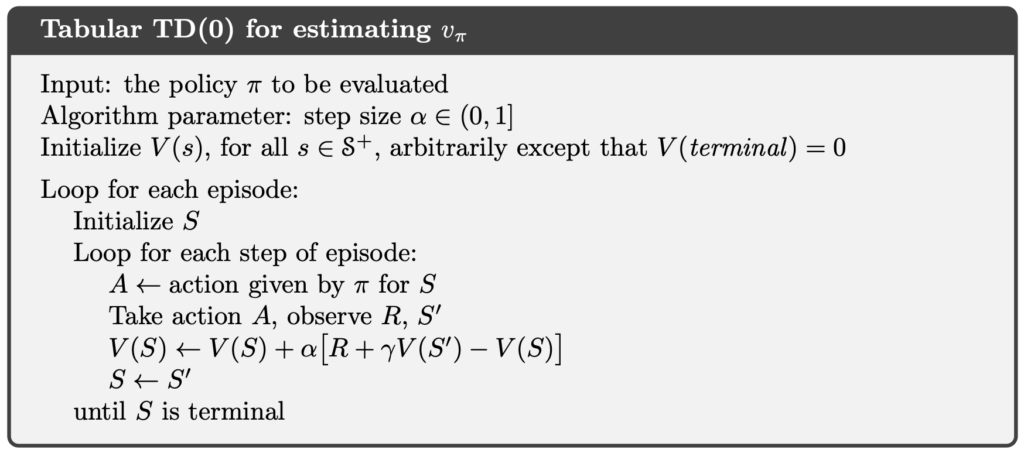
以下將介紹表格式(tabular)TD(0) prediction 的完整演算法。
時序差分控制(Temporal Difference Control)
Sarsa(On-Policy Temporal Difference Control)
我們可以將前一節介紹的 TD(0) prediction 延伸至 control 問題。如同 Monte Carlo(MC),TD 屬於 model-free 方法,並未假設已知 transition dynamics  。因此,TD 無法像 DP 那樣,對 action 的結果進行期望值計算。
然而,透過與 environment 的實際互動,agent 所蒐集到的經驗中,包含了真實執行過的狀態與動作配對  ,以及對應的 reward 與下一個 state。這些樣本可用來直接估計 action 所帶來的回報。
因此,與 MC control 相同,TD control 不再直接對 state-value function 進行操作,而是改為學習 action-value function  。在此設定下,TD control 的更新規則為:
![Q(S_t, A_t) \leftarrow Q(S_t, A_t) + \alpha [R_{t+1} + \gamma Q(S_{t+1}, A_{t+1}) - Q(S_t, A_t)]](https://s0.wp.com/latex.php?latex=Q%28S_t%2C+A_t%29+%5Cleftarrow+Q%28S_t%2C+A_t%29+%2B+%5Calpha+%5BR_%7Bt%2B1%7D+%2B+%5Cgamma+Q%28S_%7Bt%2B1%7D%2C+A_%7Bt%2B1%7D%29+-+Q%28S_t%2C+A_t%29%5D+&bg=ffffff&fg=000&s=1&c=20201002)
此更新會在每一次狀態轉移後立即進行,而不需要等待 episode 結束。更新式中所使用的五個元素  ,正好對應到一次完整的互動樣本,因此該演算法被稱為 Sarsa。
由於下一個 action  是依照目前正在執行的 policy 所選擇,Sarsa 屬於一種 on-policy TD control。
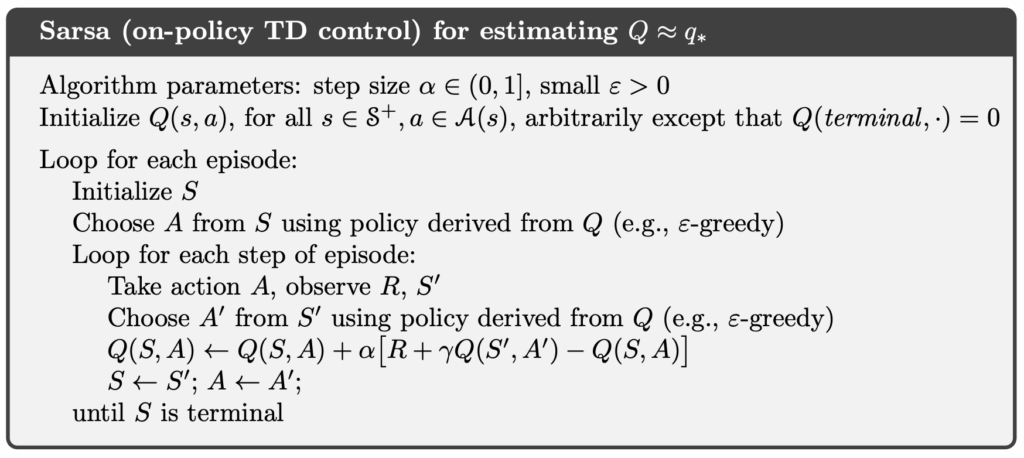
以下為 Sarsa 演算法的完整流程。
Q-Learning(Off-Policy Temporal Difference Control)
相較於 Sarsa,Q-Learning 在更新時,並不使用實際執行的下一個 action,而是直接以下一個 state 下的最佳 action 作為更新目標。換言之,Q-Learning 的更新目標近似於 optimal action-value function  。其更新式如下:
![\displaystyle Q(S_t, A_t) \leftarrow Q(S_t, A_t) + \alpha [R_{t+1} + \gamma \max_a Q(S_{t+1}, a) - Q(S_t, A_t)]](https://s0.wp.com/latex.php?latex=%5Cdisplaystyle+Q%28S_t%2C+A_t%29+%5Cleftarrow+Q%28S_t%2C+A_t%29+%2B+%5Calpha+%5BR_%7Bt%2B1%7D+%2B+%5Cgamma+%5Cmax_a+Q%28S_%7Bt%2B1%7D%2C+a%29+-+Q%28S_t%2C+A_t%29%5D+&bg=ffffff&fg=000&s=1&c=20201002)
與 Sarsa 不同,Q-Learning 在更新時,並不關心 agent 在下一個 state  實際採取了哪一個 action,而是直接假設 agent 將選擇當下估計值最大的 action。這使得 Q-Learning 在學習過程中,行為策略(behavior policy)與更新的目標策略(target policy)可以不同。
因此,Q-Learning 屬於一種 off-policy 的 TD control。在實務上,agent 可以使用具有探索性的 behavior policy(例如, -greedy)與 environment 互動,但在更新時,始終朝向 greedy policy 所對應的 進行學習。
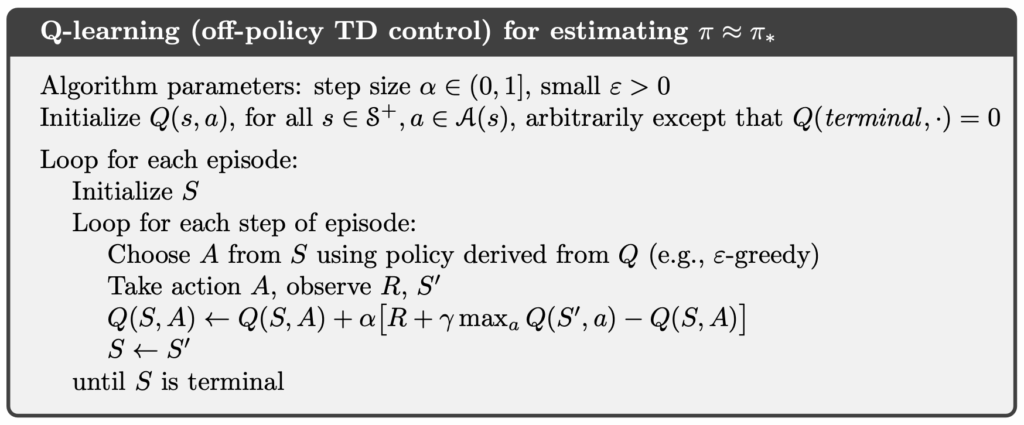
以下為 Q-Learning 演算法的完整流程。
Expected Sarsa(On-Policy/Off-Policy Temporal Difference Control)
相較於 Sarsa 使用實際執行的下一個 action  ,以及 Q-Learning 使用下一個 state 下的最大 action-value
  ,Expected Sarsa 則直接對下一個 state 的 action-value 取期望值,其更新式如下:
![\displaystyle Q(S_t, A_t) \leftarrow Q(S_t, A_t) + \alpha [R_{t+1} + \gamma \mathbb{E}_\pi [Q(S_{t+1}, A_{t+1}) \mid S_{t+1}] - Q(S_t, A_t)] \\\\ \hphantom{Q(S_t, A_t)} \leftarrow Q(S_t, A_t) + \alpha [R_{t+1} + \gamma \sum_a \pi(a \mid S_{t+1}) Q(S_{t+1}, a) - Q(S_t, A_t)]](https://s0.wp.com/latex.php?latex=%5Cdisplaystyle+Q%28S_t%2C+A_t%29+%5Cleftarrow+Q%28S_t%2C+A_t%29+%2B+%5Calpha+%5BR_%7Bt%2B1%7D+%2B+%5Cgamma+%5Cmathbb%7BE%7D_%5Cpi+%5BQ%28S_%7Bt%2B1%7D%2C+A_%7Bt%2B1%7D%29+%5Cmid+S_%7Bt%2B1%7D%5D+-+Q%28S_t%2C+A_t%29%5D+%5C%5C%5C%5C+%5Chphantom%7BQ%28S_t%2C+A_t%29%7D+%5Cleftarrow+Q%28S_t%2C+A_t%29+%2B+%5Calpha+%5BR_%7Bt%2B1%7D+%2B+%5Cgamma+%5Csum_a+%5Cpi%28a+%5Cmid+S_%7Bt%2B1%7D%29+Q%28S_%7Bt%2B1%7D%2C+a%29+-+Q%28S_t%2C+A_t%29%5D&bg=ffffff&fg=000&s=0&c=20201002)
透過明確地引入 policy 對 action 的期望值,Expected Sarsa 在更新目標的定義上,介於 Sarsa 與 Q-learning 之間。當 policy 採用 -greedy 形式,且 較大時,期望值中會顯著反映探索行為的影響,此時 Expected Sarsa 屬於 on-policy 方法,並展現出與 Sarsa 類似、偏向保守的行為。
隨著 逐漸減小,-greedy policy 會趨近於 greedy policy,探索風險在期望值中的影響也隨之降低。若在此同時,behavior policy 仍保有探索性,則用於取期望的 policy 與實際行為的 policy 便產生不一致,使 Expected Sarsa 轉為 off-policy 方法。在這種設定下,其更新目標將逐漸接近 Q-learning 的形式,因此可視為對 Q-learning 的一種連續化與泛化。
除了些微增加的計算成本之外,Expected Sarsa 通常能在學習穩定性與收斂效率之間取得良好的平衡,因此在實務上,常被視為一種同時涵蓋並改進 Sarsa 與 Q-Learning 的 TD control 方法。
Sarsa 範例
Sarsa 實作
在以下的程式碼,我們忠實地實作 Sarsa 方法。
程式碼中的 env 是 Gymnasium 的 Env 物件。Gymnasium 的前身是 OpenAI Gym。它提供了眾多的 RL 環境的數據,讓我們可以在模擬的環境中,測試 RL 演算法。
Environment 中有 env.observation_space.n 個 states。因此,state 的編號就從整數 0 到 env.observation_space.n - 1。變數 Q 是一個浮點數的 2D-array,每一個 element 都是一對 state 和 action 的 action-value 的估計值。例如,Q[0][0] 是 state 0 的 action 0 的 action-value 估計值。
import gymnasium as gym
import numpy as np


class Sarsa:
    def __init__(self, env: gym.Env, alpha=0.5, gamma=1.0, epsilon=0.1):
        self.env = env
        self.alpha = alpha
        self.gamma = gamma
        self.epsilon = epsilon

    def _random_argmax(self, q_s: np.ndarray) -> int:
        ties = np.flatnonzero(np.isclose(q_s, q_s.max()))
        return np.random.choice(ties)

    def _epsilon_greedy_action(self, Q: np.ndarray, s: int) -> int:
        if np.random.rand() < self.epsilon:
            return np.random.choice(self.env.action_space.n)
        else:
            ties = np.flatnonzero(np.isclose(Q[s], Q[s].max()))
            return np.random.choice(ties)

    def _create_pi_by_Q(self, Q: np.ndarray) -> np.ndarray:
        pi = np.zeros((self.env.observation_space.n, self.env.action_space.n), dtype=float)
        for s in range(self.env.observation_space.n):
            A_start = self._random_argmax(Q[s])
            pi[s][A_start] = 1.0
        return pi

    def run_control(self, n_episodes=5000) -> tuple[np.ndarray, np.ndarray]:
        Q = np.zeros((self.env.observation_space.n, self.env.action_space.n), dtype=float)

        for i_episode in range(1, n_episodes + 1):
            print(f"\rEpisode: {i_episode}/{n_episodes}", end="", flush=True)

            s, _ = self.env.reset()
            a = self._epsilon_greedy_action(Q, s)

            terminated = False
            truncated = False
            while not (terminated or truncated):
                s_prime, r, terminated, truncated, _ = self.env.step(a)
                a_prime = self._epsilon_greedy_action(Q, s_prime)
                if terminated or truncated:
                    Q[s, a] = Q[s, a] + self.alpha * (r + self.gamma * 0 - Q[s, a])
                else:
                    Q[s, a] = Q[s, a] + self.alpha * (r + self.gamma * Q[s_prime, a_prime] - Q[s, a])
                s = s_prime
                a = a_prime

        pi = self._create_pi_by_Q(Q)
        print()
        return pi, Q
Cliff Walking
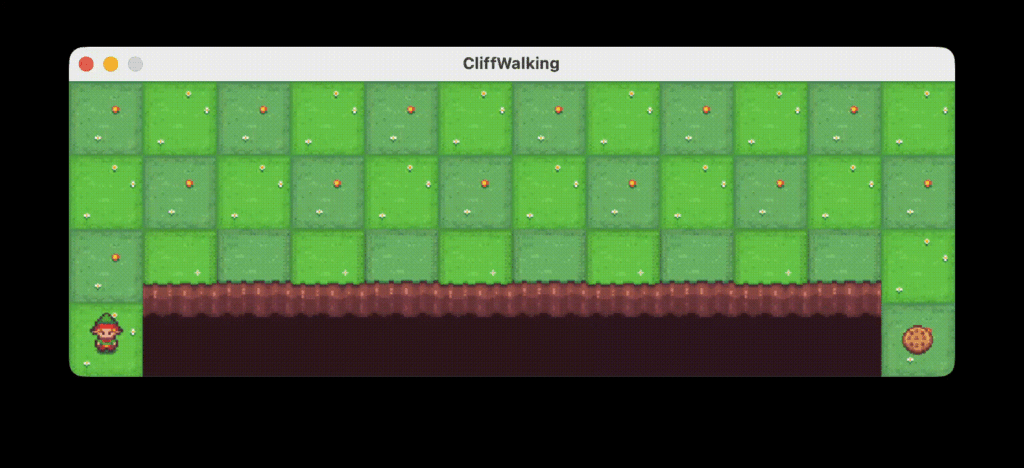
Cliff Walking 涉及在一個網格世界(grid world)中,從起始位置移動到目標位置,同時避免掉落懸崖,如下圖。
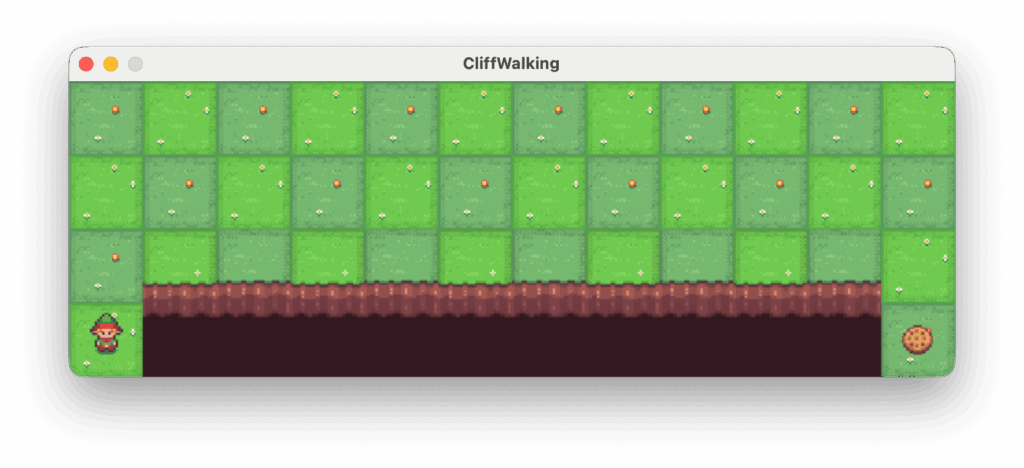
Cliff Walking 問題中每個 state 就是玩家的目前的 position。因此共有 36 個 states,分別是上面三排加上左下的格子, 。 目前的 position 由以下公式算出:

有四個 actions,分別是:
- 0:Move up
- 1:Move right
- 2:Move down
- 3:Move left
每一步皆給予 −1 reward。但若玩家踏入懸崖(cliff),則會受到 −100 reward。
import time

import gymnasium as gym
import numpy as np

from expected_sarsa import ExpectedSarsa
from q_learning import QLearning
from sarsa import Sarsa

GYM_ID = "CliffWalking-v1"


def play_game(policy, episodes=1):
    visual_env = gym.make(GYM_ID, render_mode="human")

    for episode in range(episodes):
        state, _ = visual_env.reset()
        terminated = False
        truncated = False
        total_reward = 0
        step_count = 0

        for i in range(10):
            print(f"Sleep {i}")
            time.sleep(1)

        print(f"Episode {episode + 1} starts")
        while not terminated and not truncated:
            action = np.argmax(policy[state])
            state, reward, terminated, truncated, _ = visual_env.step(action)
            total_reward += reward
            step_count += 1
            time.sleep(0.3)

        print(f"Episode {episode + 1} is finished: Total reward is {total_reward}, steps = {step_count}")
        time.sleep(1)

    visual_env.close()


if __name__ == "__main__":
    env = gym.make(GYM_ID)

    print(f"Gym environment: {GYM_ID}")

    print("Start Sarsa")
    sarsa = Sarsa(env)
    sarsa_policy, sarsa_Q = sarsa.run_control()
    play_game(sarsa_policy)
    print("\n")

    env.close()
以下是以上程式的執行結果。可以觀察到,agent 並未選擇貼近懸崖的最短路徑,而是傾向於採取距離懸崖較遠、風險較低的路徑。這是因為 Sarsa 在更新 action-value 時,使用的是由同一個 -greedy policy 所實際採樣到的下一個 action,使得探索行為所帶來的風險會直接反映在價值估計中。因此,在 Cliff Walking 這類高風險環境下,Sarsa 自然會學到較為保守、但穩定的策略。
Taxi
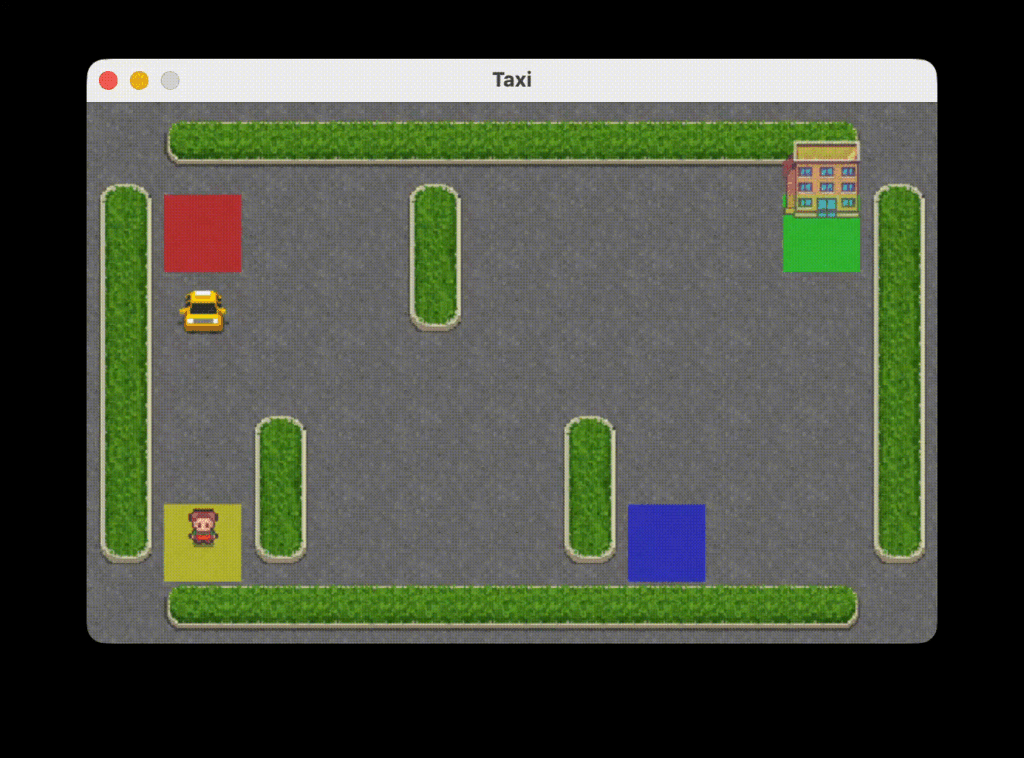
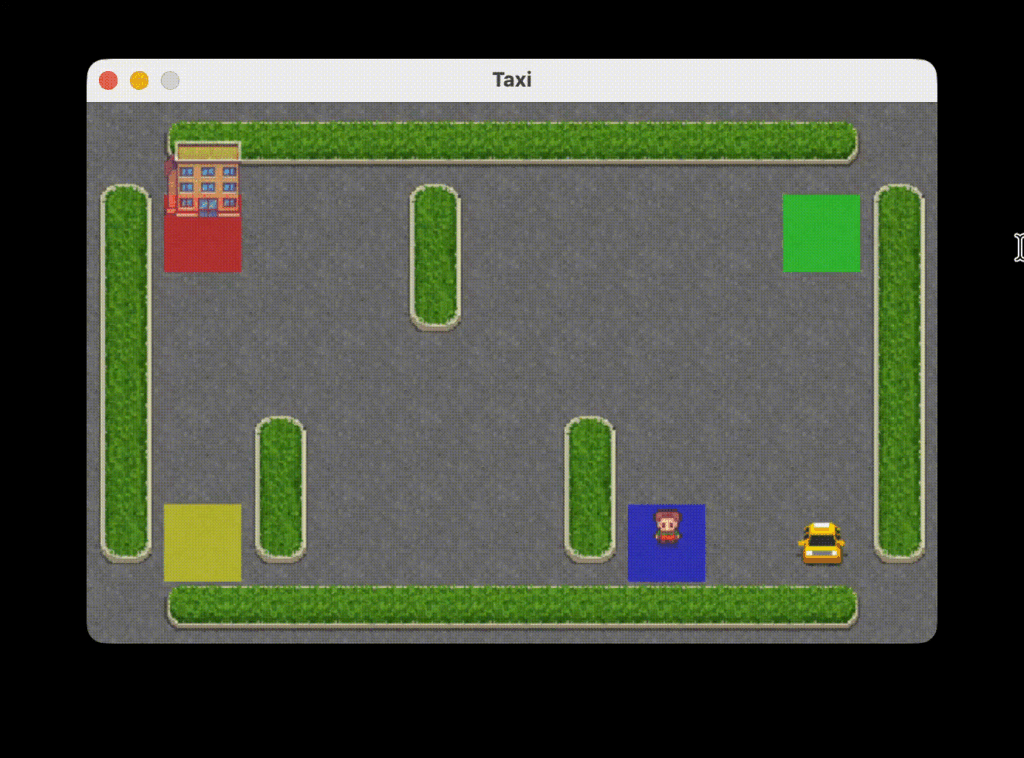
Taxi 問題是在一個 grid world 中移動,前往乘客所在的位置接送乘客,並將乘客送達四個指定地點之一,如下圖。
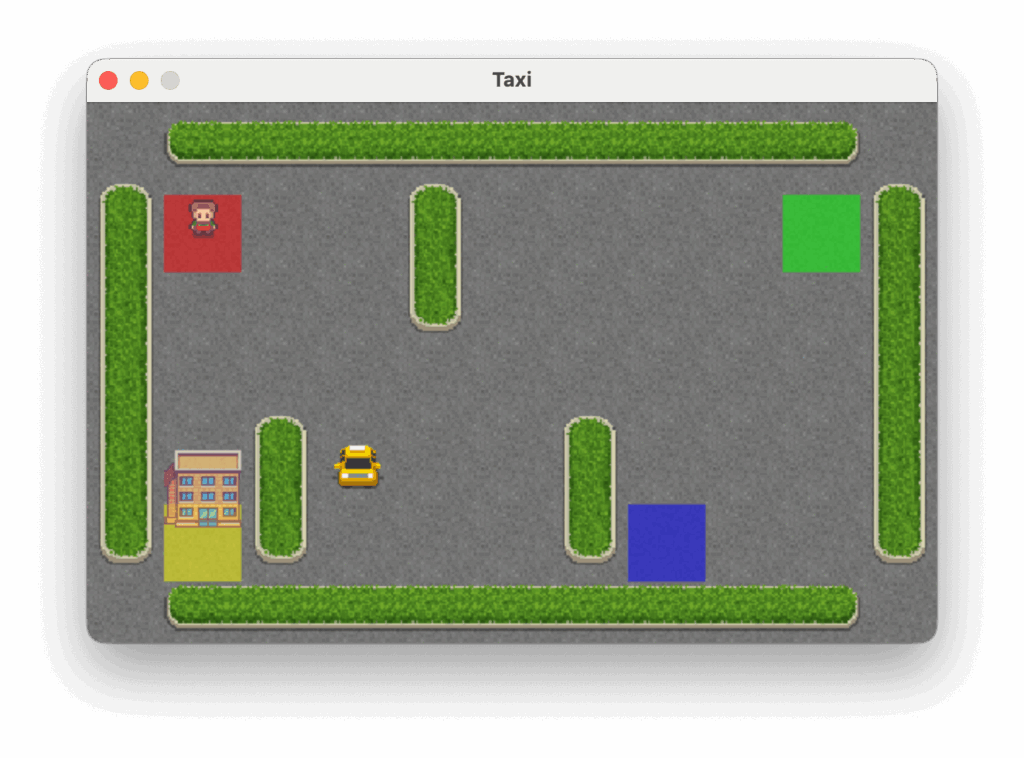
Taxi 問題中有 500 個 discrete states。每個 state 由以下公式算出:

Passenger 的 locations:
- 0:Red
- 1:Green
- 2:Yellow
- 3:Blue
- 4:In taxi
Destinations:
- 0:Red
- 1:Green
- 2:Yellow
- 3:Blue
有六個 actions,分別是:
- 0:Move south(down)
- 1:Move north(up)
- 2:Move east(right)
- 3:Move west(left)
- 4:Pickup passenger
- 5:Drop off passenger
每一步皆給予 −1 reward,除非觸發其他 reward。成功將乘客送達目的地可獲得 +20 reward。非法執行 pickup 或 drop-off 動作時,會受到 −10 reward。
import time

import gymnasium as gym
import numpy as np

from expected_sarsa import ExpectedSarsa
from q_learning import QLearning
from sarsa import Sarsa

GYM_ID = "Taxi-v3"


def play_game(policy, episodes=1):
    visual_env = gym.make(GYM_ID, render_mode="human")

    for episode in range(episodes):
        state, _ = visual_env.reset()
        terminated = False
        truncated = False
        total_reward = 0
        step_count = 0

        for i in range(10):
            print(f"Sleep {i}")
            time.sleep(1)

        print(f"Episode {episode + 1} starts")
        while not terminated and not truncated:
            action = np.argmax(policy[state])
            state, reward, terminated, truncated, _ = visual_env.step(action)
            total_reward += reward
            step_count += 1
            time.sleep(0.3)

        print(f"Episode {episode + 1} is finished: Total reward is {total_reward}, steps = {step_count}")
        time.sleep(1)

    visual_env.close()


if __name__ == "__main__":
    env = gym.make(GYM_ID)

    print(f"Gym environment: {GYM_ID}")

    print("Start Sarsa")
    sarsa = Sarsa(env)
    sarsa_policy, sarsa_Q = sarsa.run_control()
    play_game(sarsa_policy)
    print("\n")

    env.close()
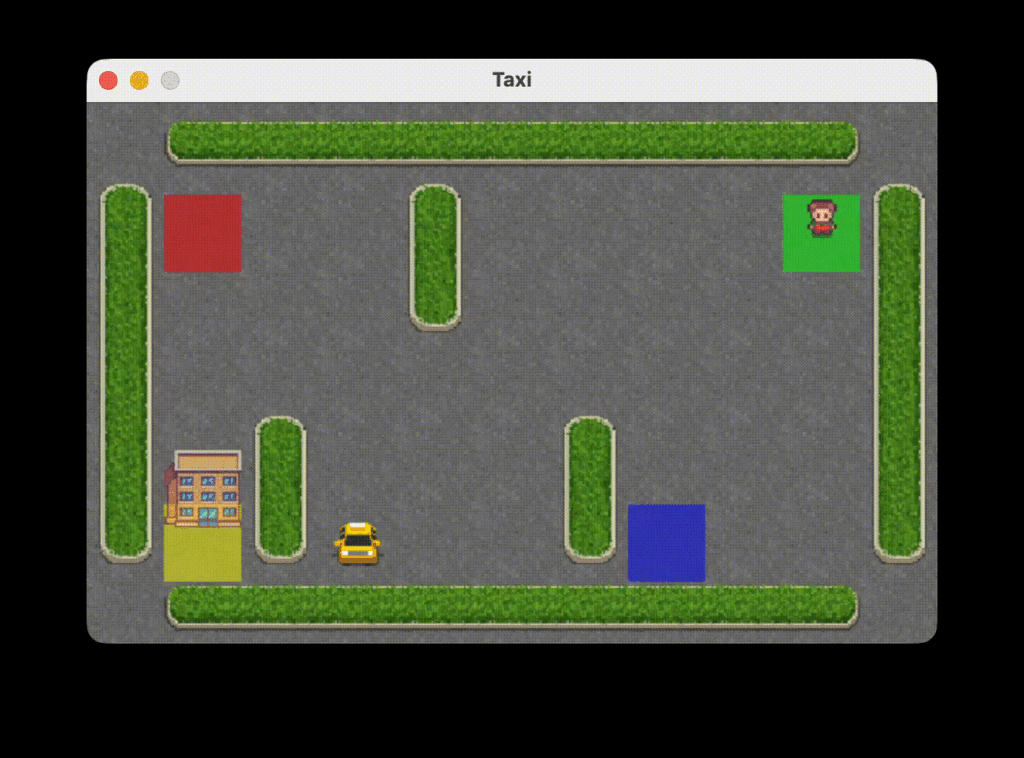
以下是上面程式的執行結果。
Q-Learning 範例
Q-Learning 實作
在以下的程式碼,我們忠實地實作 Q-Learning 方法。
import gymnasium as gym
import numpy as np


class QLearning:
    def __init__(self, env: gym.Env, alpha=0.5, gamma=1.0, epsilon=0.1):
        self.env = env
        self.alpha = alpha
        self.gamma = gamma
        self.epsilon = epsilon

    def _random_argmax(self, q_s: np.ndarray) -> int:
        ties = np.flatnonzero(np.isclose(q_s, q_s.max()))
        return np.random.choice(ties)

    def _epsilon_greedy_action(self, Q: np.ndarray, s: int) -> int:
        if np.random.rand() < self.epsilon:
            return np.random.choice(self.env.action_space.n)
        else:
            ties = np.flatnonzero(np.isclose(Q[s], Q[s].max()))
            return np.random.choice(ties)

    def _create_pi_by_Q(self, Q: np.ndarray) -> np.ndarray:
        pi = np.zeros((self.env.observation_space.n, self.env.action_space.n), dtype=float)
        for s in range(self.env.observation_space.n):
            A_start = self._random_argmax(Q[s])
            pi[s][A_start] = 1.0
        return pi

    def run_control(self, n_episode=5000) -> tuple[np.ndarray, np.ndarray]:
        Q = np.zeros((self.env.observation_space.n, self.env.action_space.n), dtype=float)

        for i_episode in range(1, n_episode + 1):
            print(f"\rEpisode: {i_episode}/{n_episode}", end="", flush=True)

            s, _ = self.env.reset()

            terminated = False
            truncated = False
            while not (terminated or truncated):
                a = self._epsilon_greedy_action(Q, s)
                s_prime, r, terminated, truncated, _ = self.env.step(a)
                if terminated or truncated:
                    Q[s, a] = Q[s, a] + self.alpha * (r + self.gamma * 0 - Q[s, a])
                else:
                    Q[s, a] = Q[s, a] + self.alpha * (r + self.gamma * np.max(Q[s_prime]) - Q[s, a])
                s = s_prime

        pi = self._create_pi_by_Q(Q)
        print()
        return pi, Q
Cliff Walking
以下我們用 Q-Learning 來解決 Cliff Walking 問題。
import time

import gymnasium as gym
import numpy as np

from expected_sarsa import ExpectedSarsa
from q_learning import QLearning
from sarsa import Sarsa

GYM_ID = "CliffWalking-v1"


def play_game(policy, episodes=1):
    visual_env = gym.make(GYM_ID, render_mode="human")

    for episode in range(episodes):
        state, _ = visual_env.reset()
        terminated = False
        truncated = False
        total_reward = 0
        step_count = 0

        for i in range(10):
            print(f"Sleep {i}")
            time.sleep(1)

        print(f"Episode {episode + 1} starts")
        while not terminated and not truncated:
            action = np.argmax(policy[state])
            state, reward, terminated, truncated, _ = visual_env.step(action)
            total_reward += reward
            step_count += 1
            time.sleep(0.3)

        print(f"Episode {episode + 1} is finished: Total reward is {total_reward}, steps = {step_count}")
        time.sleep(1)

    visual_env.close()


if __name__ == "__main__":
    env = gym.make(GYM_ID)

    print(f"Gym environment: {GYM_ID}")

    print("Start Q-learning")
    q_learning = QLearning(env)
    ql_policy, ql_Q = q_learning.run_control()
    play_game(ql_policy)
    print("\n")

    env.close()
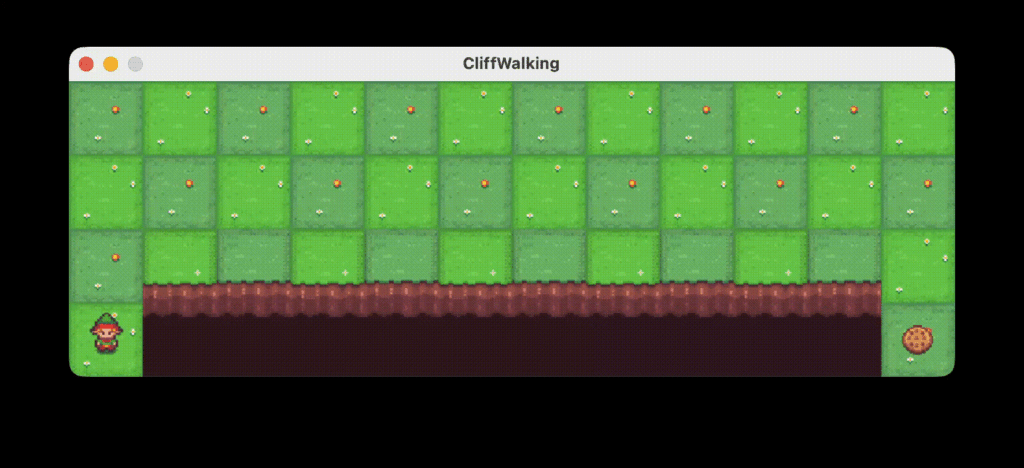
以下是以上程式的執行結果。可以觀察到,agent 會學到貼近懸崖的最短路徑,因為 Q-learning 在更新 action-value 時,使用的是 作為 TD target,而不考慮實際探索行為所帶來的風險。這使得 Q-learning 直接逼近 optimal action-value function ,在評估階段表現出較高的效率,但在訓練過程中則更容易因探索而掉入懸崖。
Taxi
以下我們用 Q-Learning 來解決 Taxi 問題。
import time

import gymnasium as gym
import numpy as np

from expected_sarsa import ExpectedSarsa
from q_learning import QLearning
from sarsa import Sarsa

GYM_ID = "Taxi-v3"


def play_game(policy, episodes=1):
    visual_env = gym.make(GYM_ID, render_mode="human")

    for episode in range(episodes):
        state, _ = visual_env.reset()
        terminated = False
        truncated = False
        total_reward = 0
        step_count = 0

        for i in range(10):
            print(f"Sleep {i}")
            time.sleep(1)

        print(f"Episode {episode + 1} starts")
        while not terminated and not truncated:
            action = np.argmax(policy[state])
            state, reward, terminated, truncated, _ = visual_env.step(action)
            total_reward += reward
            step_count += 1
            time.sleep(0.3)

        print(f"Episode {episode + 1} is finished: Total reward is {total_reward}, steps = {step_count}")
        time.sleep(1)

    visual_env.close()


if __name__ == "__main__":
    env = gym.make(GYM_ID)

    print(f"Gym environment: {GYM_ID}")

    print("Start Q-learning")
    q_learning = QLearning(env)
    ql_policy, ql_Q = q_learning.run_control()
    play_game(ql_policy)
    print("\n")

    env.close()
以下是上面程式的執行結果。
Expected Sarsa 範例
Expected Sarsa 實作
在以下的程式碼,我們忠實地實作 Expected Sarsa 方法。
import gymnasium as gym
import numpy as np


class ExpectedSarsa:
    def __init__(self, env: gym.Env, alpha=0.5, gamma=1.0, epsilon=0.1):
        self.env = env
        self.alpha = alpha
        self.gamma = gamma
        self.epsilon = epsilon

    def _random_argmax(self, q_s: np.ndarray) -> int:
        ties = np.flatnonzero(np.isclose(q_s, q_s.max()))
        return np.random.choice(ties)

    def _epsilon_greedy_action(self, Q: np.ndarray, s: int) -> int:
        if np.random.rand() < self.epsilon:
            return np.random.choice(self.env.action_space.n)
        else:
            ties = np.flatnonzero(np.isclose(Q[s], Q[s].max()))
            return np.random.choice(ties)

    def _epsilon_greedy_probabilities(self, q_s: np.ndarray):
        probs = np.ones(self.env.action_space.n, dtype=float) * (self.epsilon / self.env.action_space.n)
        max_q = np.max(q_s)
        greedy_actions = np.flatnonzero(np.isclose(q_s, max_q))
        probs[greedy_actions] += (1 - self.epsilon) / len(greedy_actions)
        return probs

    def _create_pi_by_Q(self, Q: np.ndarray) -> np.ndarray:
        pi = np.zeros((self.env.observation_space.n, self.env.action_space.n), dtype=float)
        for s in range(self.env.observation_space.n):
            A_start = self._random_argmax(Q[s])
            pi[s][A_start] = 1.0
        return pi

    def run_control(self, n_episodes=5000):
        Q = np.zeros((self.env.observation_space.n, self.env.action_space.n), dtype=float)

        for i_episode in range(1, n_episodes + 1):
            print(f"\rEpisode: {i_episode}/{n_episodes}", end="", flush=True)

            s, _ = self.env.reset()

            terminated = False
            truncated = False
            while not (terminated or truncated):
                a = self._epsilon_greedy_action(Q, s)
                s_prime, r, terminated, truncated, _ = self.env.step(a)
                if terminated or truncated:
                    Q[s, a] = Q[s, a] + self.alpha * (r + self.gamma * 0 - Q[s, a])
                else:
                    expectation = np.dot(self._epsilon_greedy_probabilities(Q[s_prime]), Q[s_prime])
                    Q[s, a] = Q[s, a] + self.alpha * (r + self.gamma * expectation - Q[s, a])
                s = s_prime

        pi = self._create_pi_by_Q(Q)
        print()
        return pi, Q
Cliff Walking
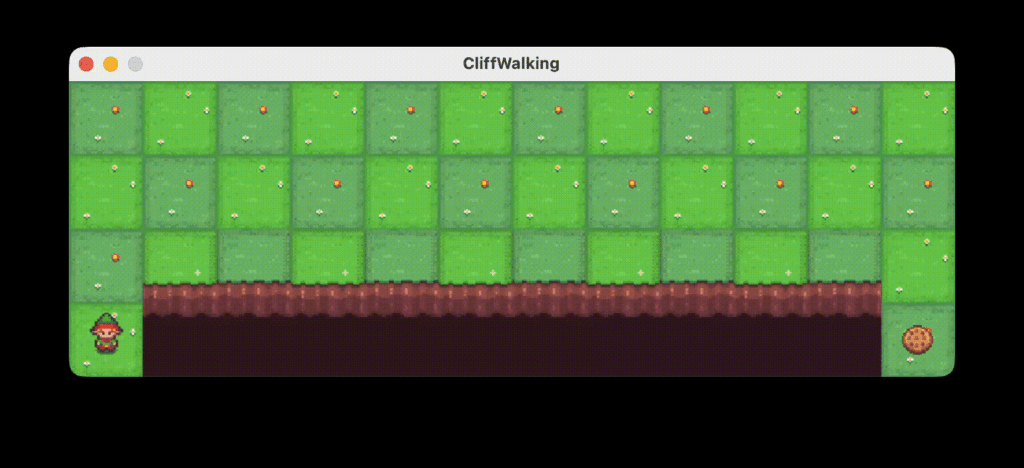
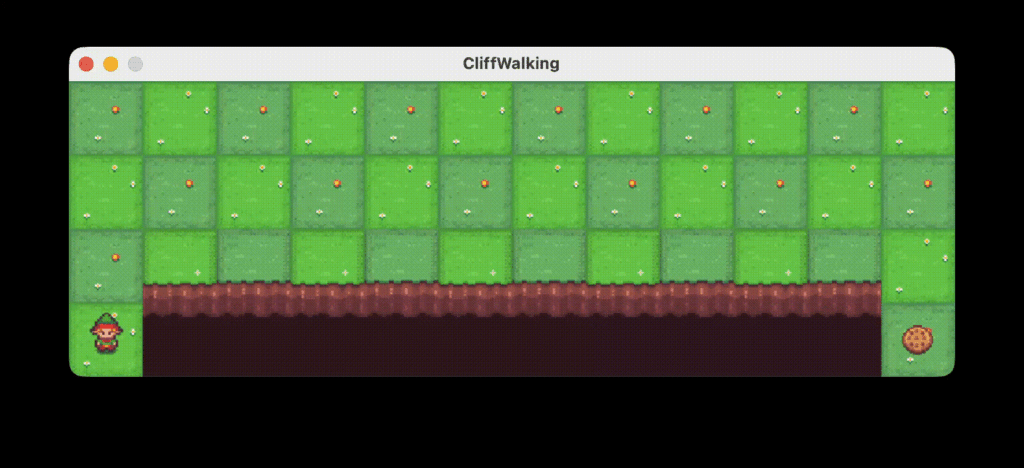
以下我們用 Expected Sarsa 來解決 Cliff Walking 問題。我們分別執行了 $latax \varepsilon=0.1$ 和  。
。
import time

import gymnasium as gym
import numpy as np

from expected_sarsa import ExpectedSarsa
from q_learning import QLearning
from sarsa import Sarsa

GYM_ID = "CliffWalking-v1"


def play_game(policy, episodes=1):
    visual_env = gym.make(GYM_ID, render_mode="human")

    for episode in range(episodes):
        state, _ = visual_env.reset()
        terminated = False
        truncated = False
        total_reward = 0
        step_count = 0

        for i in range(10):
            print(f"Sleep {i}")
            time.sleep(1)

        print(f"Episode {episode + 1} starts")
        while not terminated and not truncated:
            action = np.argmax(policy[state])
            state, reward, terminated, truncated, _ = visual_env.step(action)
            total_reward += reward
            step_count += 1
            time.sleep(0.3)

        print(f"Episode {episode + 1} is finished: Total reward is {total_reward}, steps = {step_count}")
        time.sleep(1)

    visual_env.close()


if __name__ == "__main__":
    env = gym.make(GYM_ID)

    print(f"Gym environment: {GYM_ID}")

    print("Start Expected Sarsa with epsilon = 0.1")
    esarsa_01 = ExpectedSarsa(env, epsilon=0.1)
    esarsa_01_policy, esarsa_01_Q = esarsa_01.run_control()
    play_game(esarsa_01_policy)
    print("\n")

    print("Start Expected Sarsa with epsilon = 0.001")
    esarsa_0001 = ExpectedSarsa(env, epsilon=0.001)
    esarsa_0001_policy, esarsa_0001_Q = esarsa_0001.run_control()
    play_game(esarsa_0001_policy)
    print("\n")

    env.close()
以下是以上程式的執行結果。與 Sarsa 與 Q-learning 不同,Expected Sarsa 在更新 action-value 時,會對下一個 state 下所有可能 action 的價值取期望,因此能夠將探索行為的風險平均地納入考量。
當 較大時(如:0.1),這代表 agent 意識到自己走路常常滑倒(10% 機率)於是傾向於選擇離懸崖遠一點的安全路徑。而當 非常小時(如:0.001),這代表 agent 想自己走路幾乎不會滑倒(0.01% 機率),探索風險幾乎可以忽略,平均來看走懸崖邊緣還是最划算的,學到的行為也會開始貼近懸崖。
從這個角度來看,Expected Sarsa 的行為會隨著 的設定,在風險意識與效率優先之間平滑地轉換,正好形成 Sarsa 與 Q-learning 之間的自然折衷。
Taxi
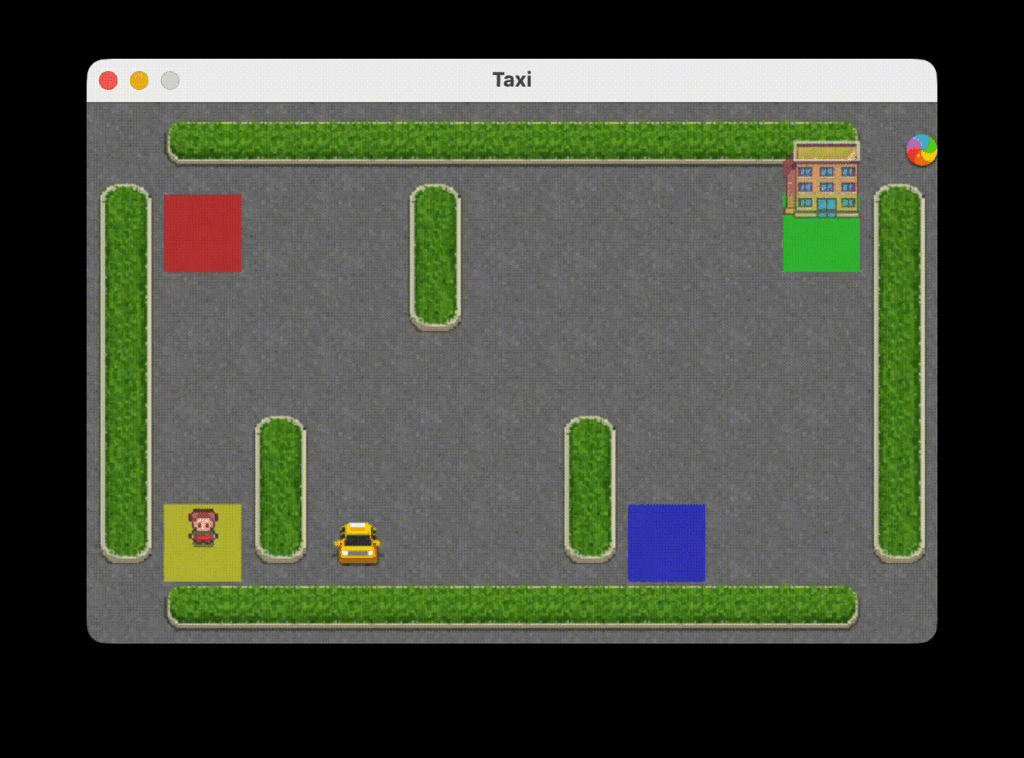
以下我們用 Expected Sarsa 來解決 Cliff Walking 問題。我們分別執行了 $latax \varepsilon=0.1$ 和 。
import time

import gymnasium as gym
import numpy as np

from expected_sarsa import ExpectedSarsa
from q_learning import QLearning
from sarsa import Sarsa

GYM_ID = "Taxi-v3"


def play_game(policy, episodes=1):
    visual_env = gym.make(GYM_ID, render_mode="human")

    for episode in range(episodes):
        state, _ = visual_env.reset()
        terminated = False
        truncated = False
        total_reward = 0
        step_count = 0

        for i in range(10):
            print(f"Sleep {i}")
            time.sleep(1)

        print(f"Episode {episode + 1} starts")
        while not terminated and not truncated:
            action = np.argmax(policy[state])
            state, reward, terminated, truncated, _ = visual_env.step(action)
            total_reward += reward
            step_count += 1
            time.sleep(0.3)

        print(f"Episode {episode + 1} is finished: Total reward is {total_reward}, steps = {step_count}")
        time.sleep(1)

    visual_env.close()


if __name__ == "__main__":
    env = gym.make(GYM_ID)

    print(f"Gym environment: {GYM_ID}")

    print("Start Expected Sarsa with epsilon = 0.1")
    esarsa_01 = ExpectedSarsa(env, epsilon=0.1)
    esarsa_01_policy, esarsa_01_Q = esarsa_01.run_control()
    play_game(esarsa_01_policy)
    print("\n")

    print("Start Expected Sarsa with epsilon = 0.001")
    esarsa_0001 = ExpectedSarsa(env, epsilon=0.001)
    esarsa_0001_policy, esarsa_0001_Q = esarsa_0001.run_control()
    play_game(esarsa_0001_policy)
    print("\n")

    env.close()
以下是上面程式的執行結果。
結論
本章介紹了的 TD prediction 與三種 TD control 方法。我們可以發現它們在形式上雖然各異,但本質上皆建立在同一套 incremental update 框架之上。Sarsa、Q-learning 與 Expected Sarsa 的差異,並不在於學習流程本身,而在於對更新目標的定義方式,以及 on-policy 與 off-policy 的取捨。透過這樣的統一視角,TD control 不再是零散的演算法集合,而是一個連續且可互相對照的學習家族。
參考
- Adam White and Martha White. Reinforcement Learning Specialization. University of Alberta and Coursera.
- Richard S. Sutton and Andrew G. Barto. 2020. Reinforcement Learning: An Introduction, 2nd. The MIT Press.


